
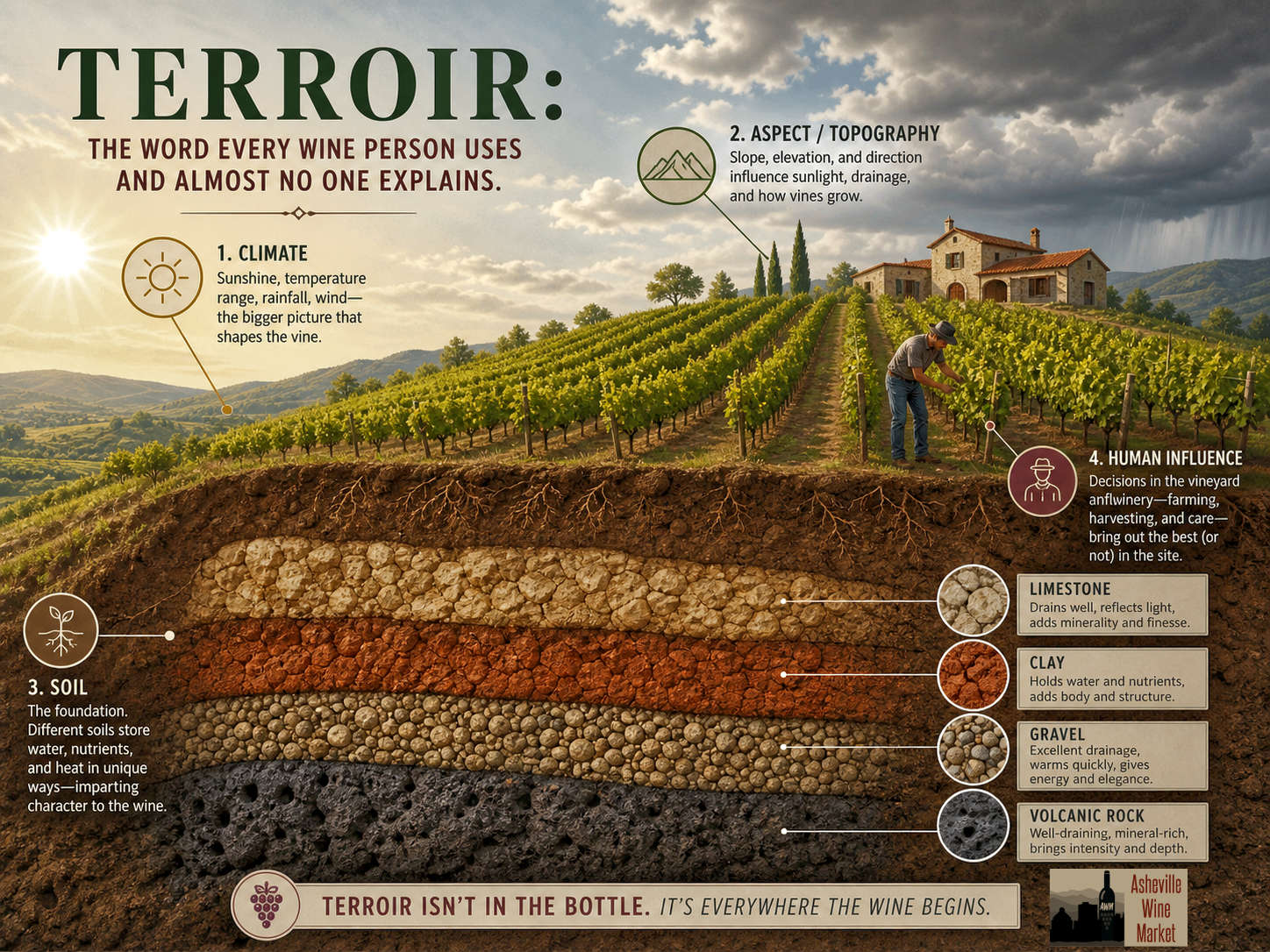
This is the first of a three-part series on terroir — one of wine's most important and least understood concepts. Next week, we’ll continue the discussion, and in week three, we'll take you to Burgundy, France, for the most famous real-world demonstration of terroir in the wine world.
You've seen it on shelf talkers. You've heard it from somms at restaurant tables. You've read it in wine reviews where it appears casually, as if everybody already knows what it means. Terroir. It sounds pretty impressive and definitely French. It sounds like the kind of word that signals you've arrived somewhere serious in the world of wine. But ask most people, even enthusiastic wine lovers, to actually define it, and you'll get a shrug and a vague gesture, maybe something about "the land." That's not wrong, exactly. But it's not even close to the full story. I’ve always found the full story one of the most fascinating things about wine.
Terroir (pronounced tair-WAHR) is, at its core, the complete natural environment in which a wine is grown and made. It is the answer to one of wine's most interesting questions: why does wine from this specific spot of earth taste different from wine made fifty yards away, using the same grape, by the same winemaker? The answer, it turns out, is not a mystery or a matter of taste. It’s geology. It’s meteorology. It’s the angle of a hillside at four in the afternoon. Terroir is the accumulated fingerprint of a place, translated into a glass of wine. Understanding it won't just make you a better wine lover; it will change what you're looking for every time you swirl and sip.
The Four Elements of Terroir
Most wine educators break terroir down into four interconnected elements. None of them operates in isolation. They’re always working together, amplifying or moderating each other in ways that ultimately show up in your glass as flavor, texture, acidity, and above all, character. Think of them as the four instruments in a quartet: each has its own voice, but great music happens when they play together.
First Element: Soil
Soil is where most conversations about terroir begin, and for good reason. It’s the medium that feeds the vine itself, anchors its roots, and draws the ever-so-important minerals and water that become the building blocks of flavor. The interesting thing about wine grapes is that they’re rebellious plants. Unlike most crops that thrive in rich, fertile soil, vines actually do their best work when they struggle. Poor, thin, well-drained soils force the vine’s roots to push deep into the earth. Sometimes twenty, thirty, even fifty feet down in search of water and nutrients. That depth brings the vine into contact with the mineral character of the underlying rock, and those minerals leave traces in the wine.
Different soils produce strikingly different results. Limestone, found throughout Champagne, Chablis, and much of Burgundy, tends to produce wines of high natural acidity and a distinctive chalky precision. My late friend Craig Baker was fond of describing this minerality as the “tension in a wine.” Volcanic soils, like those found on Sicily's Mount Etna or the Greek island of Santorini, give wines a smoky, almost ash-like quality that’s instantly recognizable once you've experienced it. Heavy clay retains water and warmth, producing rounder, fuller-bodied wines with softer acidity. The famous gravel beds of the Médoc on Bordeaux's Left Bank drain rapidly and absorb heat during the day, releasing it slowly at night; conditions perfectly suited to the late-ripening Cabernet Sauvignon. Soil isn't just the ground the vine stands in. It is an active participant in the flavor of what ends up in your glass.
Second Element: Climate
Climate is arguably the single biggest driver of style differences in wine, and it operates at three distinct scales that are worth understanding on their own.
Macroclimate is the broad regional climate. These are the general weather patterns that define a wine region or even an entire country. Mediterranean climates (southern France, California, central Spain) bring warm, dry summers and mild winters, producing ripe, generous wines. Continental climates (Burgundy, Germany, much of Eastern Europe) experience dramatic seasonal temperature swings, producing wines with high acidity and pronounced structure. Maritime climates (Bordeaux, New Zealand, the Pacific Northwest) are moderated by proximity to large bodies of water, with more rainfall and fewer temperature extremes.
Mesoclimate is the climate of a specific valley, hillside, or village — the conditions that make one commune within a region behave differently from its neighbor. A hillside that channels cold air differently, a valley that traps afternoon heat, a ridge that blocks coastal fog: these mesoclimatic variations are why two villages in the same appellation can produce wines with distinctly different characters.
Microclimate zooms in even further to the conditions right at the level of the vine itself. How much direct sun does a particular row of vines receive? Is it exposed to afternoon wind that keeps it cool? Does morning fog linger here longer than twenty meters away? These hyper-local conditions influence when grapes ripen, how thick their skins become, and how much natural acidity they retain. In wine regions where the difference between a good vintage and a great one is measured in degrees, microclimate matters enormously.
Next week: The third and fourth elements of terroir.