
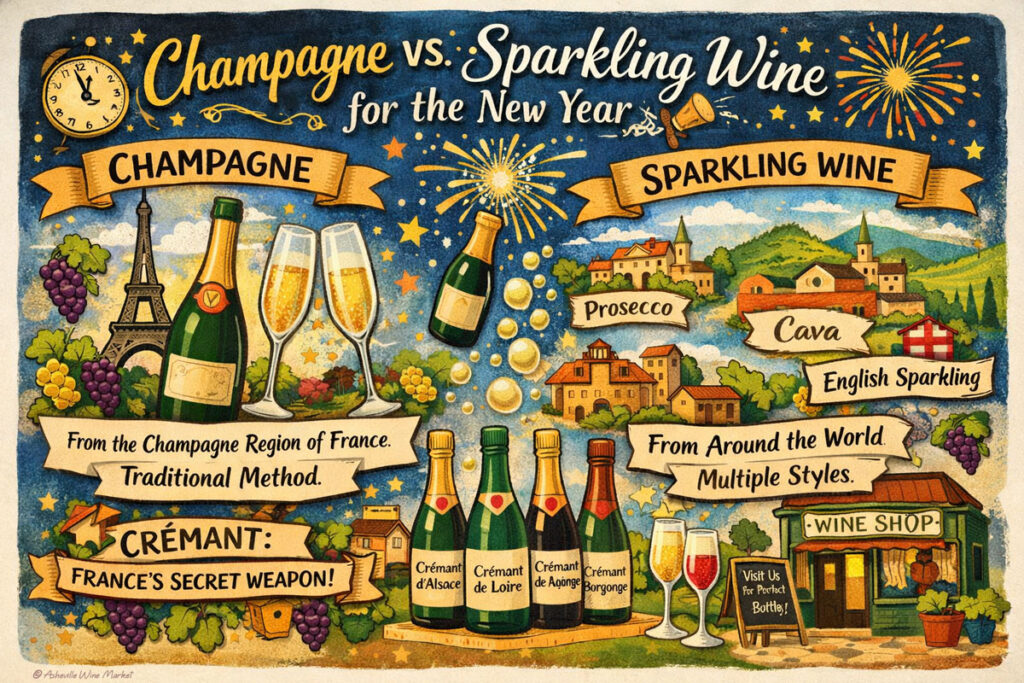
AWM 2026 Quick Guide to picking your New Year's Bubbly
There’s a reason Champagne and sparkling wine are the default bubbly for New Year’s. It’s crisp, festive, food-friendly, and perfectly suited to leading us into the New Year, whether it’s a room full of people talking over each other, or a quiet night at home by the fireplace with that special someone.
Champagne is the go-to for a lot of folks, and it’s easy to understand why. It’s one of the most tightly defined and highly celebrated wine regions on earth, and that fame and focus certainly show up in the glass. When you want to pop the cork on something that feels “occasion-worthy,” it tops the list.
Here’s where it gets a little more interesting: you can ring in the New Year in the same festive verve with sparkling wine from all over the world. The bonus with sparkling wine is that you’ll get that same celebratory vibe at a friendlier price point.
So what’s the real difference between Champagne and sparkling wine?
Champagne is a place. It’s a specific region in northeast France, with super-strict rules about grapes, yields, aging, and production. If it isn’t from Champagne, it isn’t Champagne—full stop, end of story. Another key difference is that Champagne is made in the traditional method, and the second fermentation that produces those lovely bubbles happens right in the bottle. Champagne typically spends meaningful time aging on the lees before release —the key to all of those yeasty notes of brioche we all love.
Simply put, sparkling wine is the broad category of bubbly wines. While some sparkling wine is made in the traditional Champagne method, the vast majority isn’t. Many regions use the tank/Charmat method, where the second fermentation is created in pressurized stainless-steel tanks. Charmat-method bubbly is usually bright and fruit-forward, making these sparklers great for parties, cocktails, and salty snacks.
To recap: Champagne is a protected region with lots of strict rules, while sparkling wine is the entire global family of bubbly goodness. The good news for savvy wine lovers is that the sparkling wine world is chock full of reasonably priced overachievers.
While Champagne is the undisputed king of celebratory sparklers, here are some other members of the sparkling wine world to put on your vinous radar:
Italy
Prosecco (most often Charmat/tank method) is the easy, friendly crowd-pleaser—great for aperitif mode and salty snacks.
Franciacorta and TrentoDOC (both are Italy’s riff on traditional Champagne method) are Italy’s more Champagne-like options: structured, food-ready, and often seriously impressive. Unfortunately, they tend to also share Champagne pricing.
Spain
Cava (traditional method) is one of the best “real-deal” values in the sparkling universe—especially if you like drier, more savory styles.
Germany & Austria
Sekt is all over the map, from delightfully simple and cheerful to elite traditional-method bottles with serious pedigree. If you like Germanic precision and high-toned refreshment, this is your bubbly.
England
English traditional-method sparkling has gone from curiosity to heavy hitter. If you like Champagne-adjacent structure with a cool-climate edge, it’s worth a look; however, once again, we’re talking Champagne-like pricing.
United States
California has a deep bench of bubble producers that produce sparklers that range from bright and straightforward to serious traditional-method bottles. You’ll also find great fizz coming out of places like Oregon, Washington, and beyond.
Southern Hemisphere
Tasmania (Australia) and South Africa’s Cap Classique are two regions that consistently deliver quality for the price.
Crémant
This is without question the true secret weapon of French bubbles. If you’re looking for top-quality New Year bubbles, on a friendlier budget, Crémant is the smart play. Crémant is the generic term for French sparkling wine made outside of the Champagne region. In many cases, Crémant is made in the traditional Champagne method, and it always punches way above its reasonable price point.
A few of our favorite Crémants:
Crémant d’Alsace – bright, dry, and versatile (excellent with salty apps and anything fried)
Crémant de Loire – crisp and friendly, fantastic with seafood and especially goat cheese
Crémant de Bourgogne – Burgundy’s take: often a little more “vinous” and certainly one of the most Champagne-like.
Crémant du Jura / Limoux / Bordeaux / Die – each has its own personality, all worth exploring
If you want something that feels “special” without ponying up Champagne cash, Crémant is your secret weapon. People will assume you spent more than you did—and you don’t really need to correct them.
Whether you’re throwing a full‑on New Year’s bash, keeping it low‑key over dinner, hosting a living‑room countdown, or “Yay, we made it to midnight,” [if you’re like Hammond and me] swing by, and we’ll set you up with a terrific overachieving sparkler that won’t break the bank.