
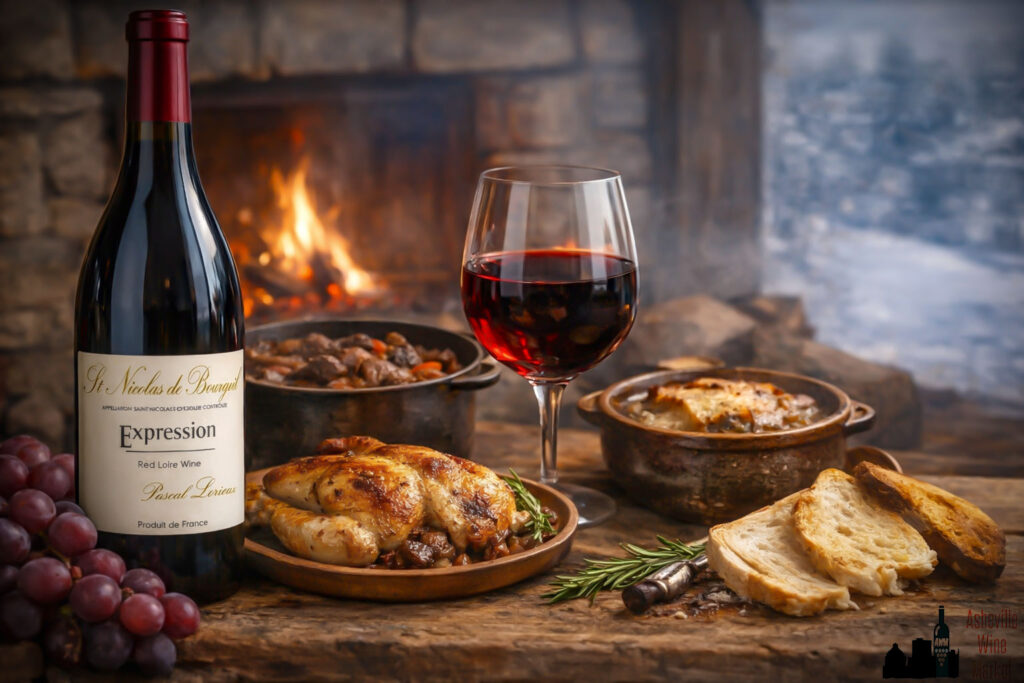
As the Western North Carolina winter continues, and February wraps us in its gray, frosty fold, Hammond and I start craving the kind of dinners that warm both the house and the soul. Roast chicken, slow-cooked daubes, ragouts, and soothing bowls of onion soup and chili top the list of our favorites. Of course, nothing fits these soul-satisfying foods quite like a glass of red wine. Enter Cabernet Franc, which is, in my opinion, the most underrated hero of the winter wine world.
If Cabernet Sauvignon is the rockstar blockbuster grape we all know and love, then Cabernet Franc is the quiet indie-rock journeyman; often more interesting, and always working harder to please. While the grape may play second fiddle to its more famous counterpart, there’s one interesting tidbit we can’t ignore: along with Sauvignon Blanc, Cabernet Franc is actually one of Cabernet Sauvignon’s parent grapes, firmly cementing its place in vinous royalty.
Written evidence of Cabernet Franc first appears in the early 1600s in Bordeaux, noted in monastery and estate records under the name “Bouchet.” At the time, clerical archives were the only place to find documentation of grape varietals and vineyard plantings. The grape’s move north to its more famous second home in the Loire Valley is credited to Cardinal Richelieu, the ambitious powerbroker who served as Louis XIII’s chief minister. With the King’s full blessing, the Cardinal actively encouraged the cultivation of Cabernet Franc and had vine cuttings from Bordeaux sent to be planted at the Abbey of Bourgueil in the Loire Valley.
Cabernet Franc ripens a bit earlier than Cabernet Sauvignon, and that’s the key to its ability to thrive in cooler climates. This is crucial for adequate ripening in higher-elevation, cooler-climate regions like coastal Chile and, notably, New York’s Finger Lakes. Even here in the Southeast, you’ll find perfectly placed pockets of vineyards in Virginia and North Carolina. I remember Bernard, the previous winemaker at the Biltmore Estate, noting that Cabernet Franc was his favorite varietal to work with here in Western North Carolina.
So what does Cab Franc actually taste like? Imagine raspberry and tart cherry, mixed with earthy notes of tobacco leaf and a touch of sage, along with a hint of violet and a super-subtle whiff of bell pepper. Depending on the terroir, it can range from medium-bodied and aromatic, with graceful tannins, to a full-on bruiser with steak-worthy structure. It deftly dances that sweet spot between structure and flexibility, making it equally at home with a steak, roasted bird, burger, or a plate of roasted root veggies.
For me, it’s balance that makes Cabernet Franc such a versatile winter food wine. Its acidity cuts through rich sauces, while its herbal edge plays nicely with the savory, earthy flavors of hearty daubes and ragouts. It’s not too heavy, so it won’t step on your roasted poultry or pasta; however, there’s enough backbone for a red meat braise or a pot of sausage and lentils. I can’t think of too many other red wines that adapt as easily to such a wide range of food.
If you’ve ever talked food with me at the shop, then you’ll know that the phrase “roasted chicken” will more than likely enter the conversation— I think I probably say those two words at least a few times every day! So, continuing with that thought, roasted chicken is a great example of why this grape is so food-friendly. A well-made Cabernet Franc can lift your perfectly roasted chicken to the next level. The red fruit dances with crispy skin and pan juices, and the herbal notes beautifully echo any thyme or garlic you tucked into the bird. Savory mushroom dishes are another great pairing example, and the wine’s earthy beam enhances the depth of the mushrooms, and the bright fruit keeps everything feeling lifted.
I know I seem to always write about Old World Wines; however, of course, Cabernet Franc isn’t confined to just the Old World. American producers are embracing it as well. From the pepper-saturated expressions of the Finger Lakes to ripe, floral examples from California’s Sierra Foothills and Paso Robles, there’s really a Cabernet Franc for every palate and budget. You may have already enjoyed this grape in a Right Bank Bordeaux blend, so I’d suggest exploring what it can do on its own.
To get the most out of your Cab Franc, give it a little time to open up. A quick 20–30-minute decant coaxes out nuance and softens the edges. Or, for a cool vinous experiment, sip it along with a Cabernet Sauvignon and see if you can spot the family resemblance. You’ll notice Cab Franc tends to feel a bit leaner, livelier, and more aromatic.
So, as February in Western North Carolina marches on, and thoughts of cozy winter dinners keep calling your name, consider making Cabernet Franc one of your go-to winter reds. It checks a lot of boxes: it’s elegant, earthy, and endlessly versatile at the table.