
Wine's Second Job -- Elevating your culinary creations
When most folks think of wine, it evokes a picture of easy-going evenings with friends and family, enjoying that sublime combination of good food and good company. Wine always supplies that special spark to the evening and makes everything taste a little better. Or maybe it’s the simple comfort of a sturdy Rhône red by the fire. For Hammond and me, wine certainly fills those roles, but it also wears another hat: it’s the quiet secret ingredient that can transform your meal from fine to unforgettable.
Long before I got into the wine business, wine was already woven into my daily life as a chef. Every kitchen I ran featured a lineup of wines meant for cooking. I always considered wine a kitchen tool, definitely as crucial as other kitchen essentials like stock or butter. My professional kitchen days are long behind me, and I love writing about the joy of wine inside the glass; however, I also love writing about wine outside of the glass as well.
Wine has been part of civilization’s culinary toolkit for thousands of years. Ancient cooks in China, Greece, and Rome fully understood its value, and as these cultures traded and mingled, so did their kitchen practices. Cooking with wine spread across the civilized world because it made food delicious. Wine brings flavor, brightness, depth, and structure, and I can’t imagine a kitchen without it.
In today’s modern kitchen, there are nearly endless ways to use our favorite adult beverage. In marinades, wine can tenderize tough cuts. It’ll provide just the right touch of brightness, lending a clean beam of acidity to your deep, rich sauces and stews in ways nothing else can. Wine even takes center stage with Coq au Vin, Boeuf Bourguignon, Osso Buco, or a coastal Spanish Mariscada. These culinary classics are built around wine in a starring role, not as a supporting player.
So what should you use? Be choosy—within reason. You don’t need to sacrifice that special bottle to the sauté pan. The age-old mantra still rings true: if you wouldn’t enjoy it in your glass, you shouldn’t cook with it. Perhaps the only hard-and-fast rule is to take a pass on bottles labeled “cooking wine” at the supermarket. Those are basically salty, manufactured shortcuts that tend to make food taste like the top came off of your salt shaker.
If your culinary masterpiece leans red, reach for one with easy-going tannins and a fruit-forward personality. A red with softer tannins and supple fruit is way less likely to step on your other ingredients. For the best results with white wine, look for plenty of fruit, and steer completely clear of oak. Cool-climate whites aged in stainless are ideal, and I’m especially fond of Pinot Grigio, as it reduces like a champ. Also, avoid super-intense mineral-driven whites, as they can get a little austere when reduced.
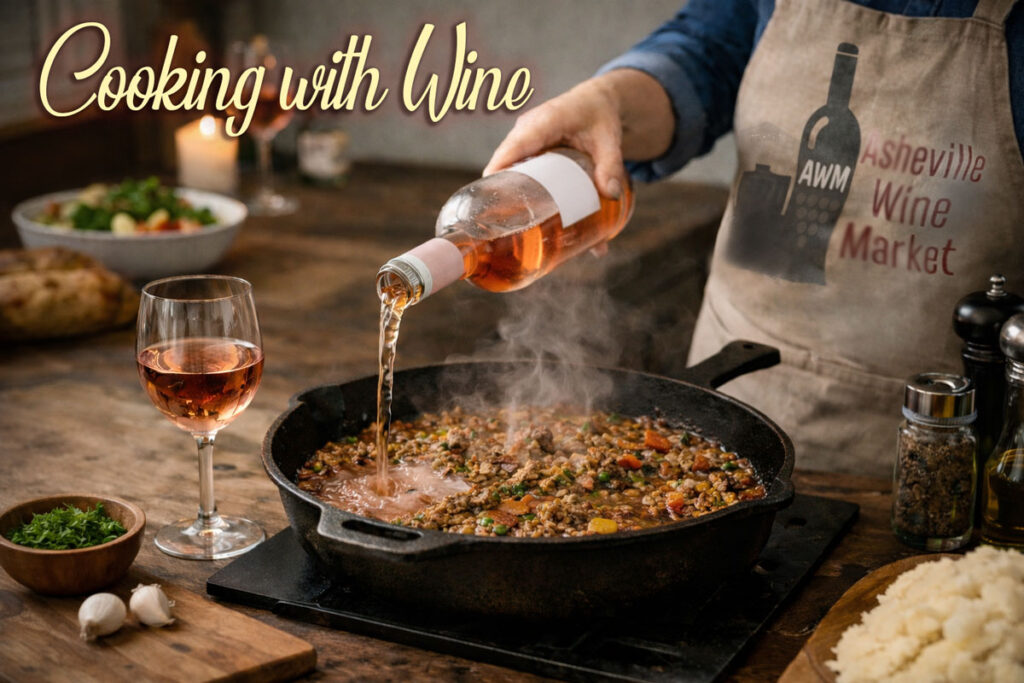
It may surprise you to find out the real sleeper in the kitchen is Rosé. A couple of years back, when Hammond and I enjoyed a visit from my sister Linda and her husband Tom, I made a Shepherd’s Pie. A red would have completely stepped on my lighter version of this classic; a white would have been completely lost, making little or no contribution. Rosé, on the other hand, slipped right into the perfect spot, lifting the flavors, adding just the right brightness, and giving this cool‑weather classic the balance I wanted. If you need a new culinary rule of thumb for 2026, it’s this: don’t overlook pink in the kitchen.
Next week, we’ll dig into deglazing, reductions, marinades, and the other small miracles wine can perform once it hits a hot pan.