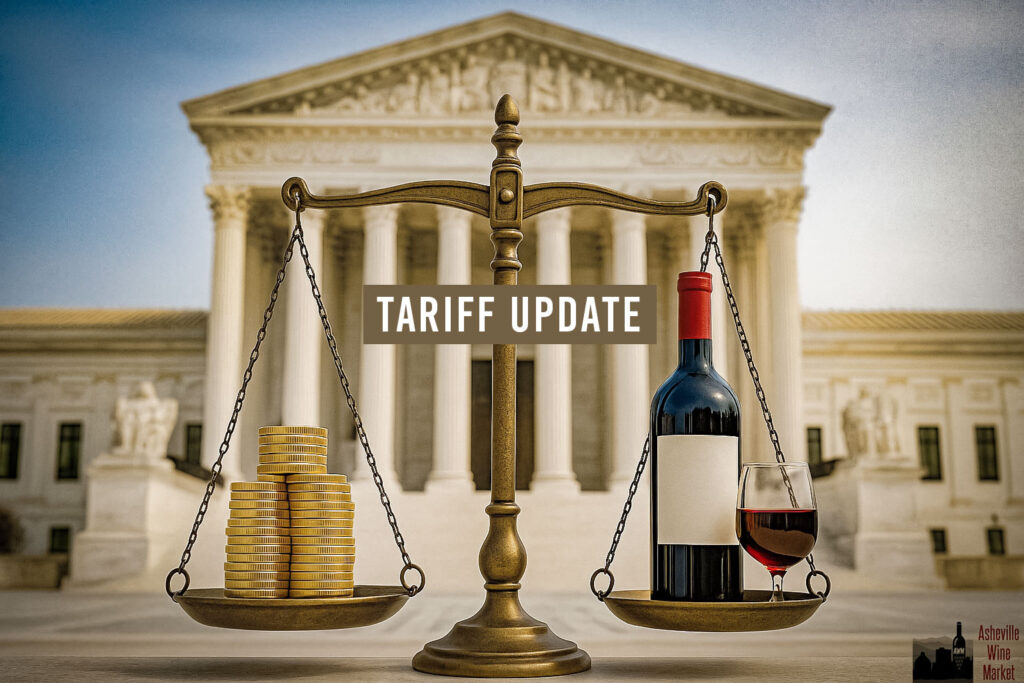
As you might expect, we listened to the entire Supreme Court oral argument with keen interest last week. Here’s my AWM Cliff Notes version of what transpired and — in my opinion — what the future may hold for wine lovers.
The justices seemed pretty skeptical that the White House can use the 1977 IEEPA emergency law to slap broad tariffs on imports. The fight boiled down to one word — “regulate” — and whether “regulate importation” covertly includes the power to tax. Several justices kept noting that if Congress meant “tariff,” it would have said “tariff,” and Chief Justice Roberts in particular kept returning to the simple point: tariffs are taxes, and taxing power belongs to Congress.
Much of the morning dipped firmly into semantics, turning many of the arguments into what seemed more like a grammar clinic. The Court kept circling back to the IEEPA’s verbiage — investigate, block, regulate, direct and compel, nullify, prevent or prohibit — and asserted that none of them typically means “raise revenue.”
A few moments stood out with individual Justices. Barrett asked for any historical example where “regulate importation” authorized tariffs; none was offered. Gorsuch warned about a “one‑way ratchet” if the executive branch gained that power. Kavanaugh pointed out that no president has tried this before. Sotomayor was blunt — “Tariffs are taxes” — and Jackson stressed IEEPA was meant to limit, not enlarge, emergency authority. Together, those exchanges made the government’s case look a little like an uphill battle.
Some conservatives on the bench introduced hypotheticals. Thomas asked whether targeted tariffs could be used as leverage in an extreme hostage scenario. Alito asked whether quotas and embargoes—already allowed under IEEPA—undercut the need for a new tariff power. Those questions seemed less likely to produce votes to uphold and more like ways to find the narrowest way to say no.
From what I can discern, most of the folks who follow and report on Supreme Court rulings expect an opinion that will lean heavily into classic textual tenets, resulting in this rather narrow opinion: IEEPA can let a president manipulate the flow of trade in an emergency; however, it can’t be used to create new tariffs/taxes.
What does this mean for our favorite adult beverage? If the Supreme Court rejects the IEEPA‑tariff theory, current duties would likely be blocked or trimmed back to last year’s moderate levels, tremendously easing pressure on wine imports. This would, of course, be a massive boost for shops, restaurants, small importers, and, ultimately, consumers who’ve been dealing with significantly higher costs.
Well, it’s not all roses, so don’t pop the cork for that victory lap yet — other statutes (Sections 232, 201, 301) will remain in play regardless of the Court’s decision. I will note that ratcheting up any of these new statutes would probably be a much slower process and most likely way more targeted.
The bottom line — and I’m pretty much reading tea leaves here— is that I see this leaning toward a ruling that “regulate” doesn’t include tariff power, so the IEEPA duties are probably unlawful. At the same time, broader trade tools remain in place for the administration so it will probably tee up another fight about tariffs in the future.
An opinion on this week’s proceedings is expected as early as the spring or as late as June or early July 2026.