
For a good chunk of last year, it seemed the tariffs weren’t all that terrible, and we were skating by pretty nicely. Sadly, I think we all realize now that may have been wishful thinking. Although we’ve been living with the tariffs for close to a year, the real impact didn’t fully hit home until early November for most folks, including us at AWM. There are a couple of reasons why we didn’t feel the pain during the summer and why we’re definitely feeling it now.
Last year in January, when the administration began talking about tariffs, many companies “front-loaded,” buying up large amounts of goods. I actually did as well, and we still have a supply of “pre‑tariff” goods on the shelf at pre‑tariff prices. As spring turned into summer, many companies were still selling those front‑loaded goods, and we continued to enjoy the benefit of those goods from ethical suppliers who didn’t immediately raise prices.
The second reason we didn’t feel the tariff burn right away dovetails with the front‑loading. After the tariffs were announced in April, transatlantic container shipping ground to an abrupt halt. Companies didn’t want to import goods when the cost of their products could change in the middle of the Atlantic before reaching port. That created a three‑ to four‑month hiatus before regular shipping resumed with any predictable rhythm.
That shipping hiatus delayed the impact of the tariffs throughout the summer and into early fall, mainly because limited new goods were entering the country. The trouble wasn’t only the tariff itself; the bigger problem was the uncertainty created by the legal basis the administration used for the tariffs. Importers paused. Distributors hesitated. My own AWM selections sat on hold because I couldn’t commit to wines that might land with a surprise surcharge.
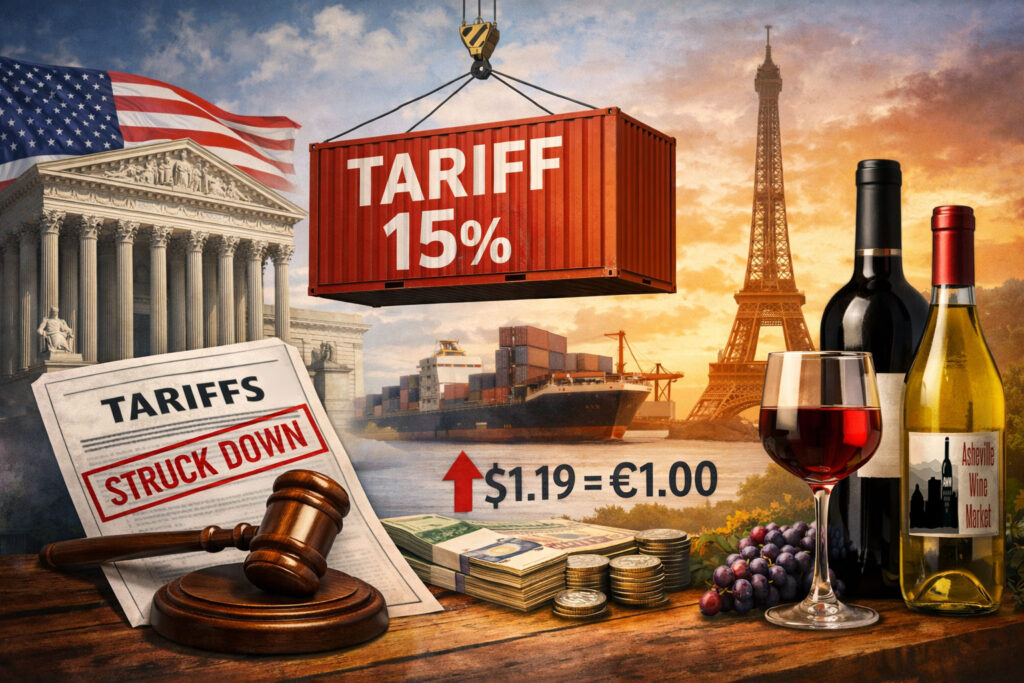
Then there’s a third gut punch with EU imports: the dollar. Through 2024 and into the first quarter of 2025, the exchange rate was close to parity, roughly $1.04–$1.08 to the euro. We enjoyed that for a good stretch, and it made it possible to keep many everyday European bottles in the sweet spot. After the tariff chaos ramped up, the dollar took a major dive. Lately, we’ve been sitting around $1.18–$1.19. That may not seem like much; however, it bumps the cost before tariffs even enter the equation. That’s also why you’ve seen other imported favorites creep up significantly as well—cheeses, Italian pasta, olive oil, and coffee. Unfortunately, it’s all the same supply‑chain math.
Now, on to what changed yesterday. The Supreme Court ruled that the International Emergency Economic Powers Act (IEEPA) does not authorize the President to impose broad tariffs. This eliminates the legal basis for the prior tariff structure.
So, does that mean tariffs are “over”? Sadly not. The key point is that the Court’s decision changes how tariffs can be imposed, not whether tariffs can exist at all. Within hours, the administration pivoted to a new legal basis, announcing a global tariff under Section 122 of the Trade Act of 1974, which allows an across‑the‑board tariff for a limited time window. It was floated as 10% on Friday and then raised to 15% on Saturday, which is also the maximum rate that particular legal authority allows.
What does that mean for AWM customers in plain English? Two things are significant. First—and the part I truly hate—there’s no magical reset to pre‑tariff pricing. That’s because a new global tariff is now in effect, even though the old IEEPA structure has been invalidated. Second, we’ll hopefully experience a little less overall uncertainty with the supply chain and import logistics. Since we’re no longer dealing with the “emergency powers” framework, hopefully we can stop trying to predict what the next surprise will be. More predictability and less Kentucky windage will be a huge help to everyone in the wine business.
There’s also a “maybe later” scenario worth watching: refunds. The Court didn’t hand out refunds in its ruling, but invalidating the legal basis for the IEEPA tariffs opens the door for importers to seek reimbursement for what they’ve already paid. If refunds do happen, that relief won’t be instant, and it won’t fix every price. I’m certainly not naïve enough to think we’ll see prices coming down; however, it could help some importers, which hopefully helps all of us downstream.
Here’s my take on all of this: we’re in a moment when we can’t depend on Washington to deliver stability. So instead, I’m going to continue creating my own. I’m doubling down on sourcing wines that offer the best quality at the best possible value, even with a declining dollar and the tariffs.
That’s my number‑one mission for 2026: bring back affordable, everyday wines made by independent family vignerons and well‑run co‑ops. Samples are already on the way, and I’m looking for our first order to arrive in late spring. When those wines arrive, of course, you’ll be the first to know. As always, local and regional regulars will get the best pricing.