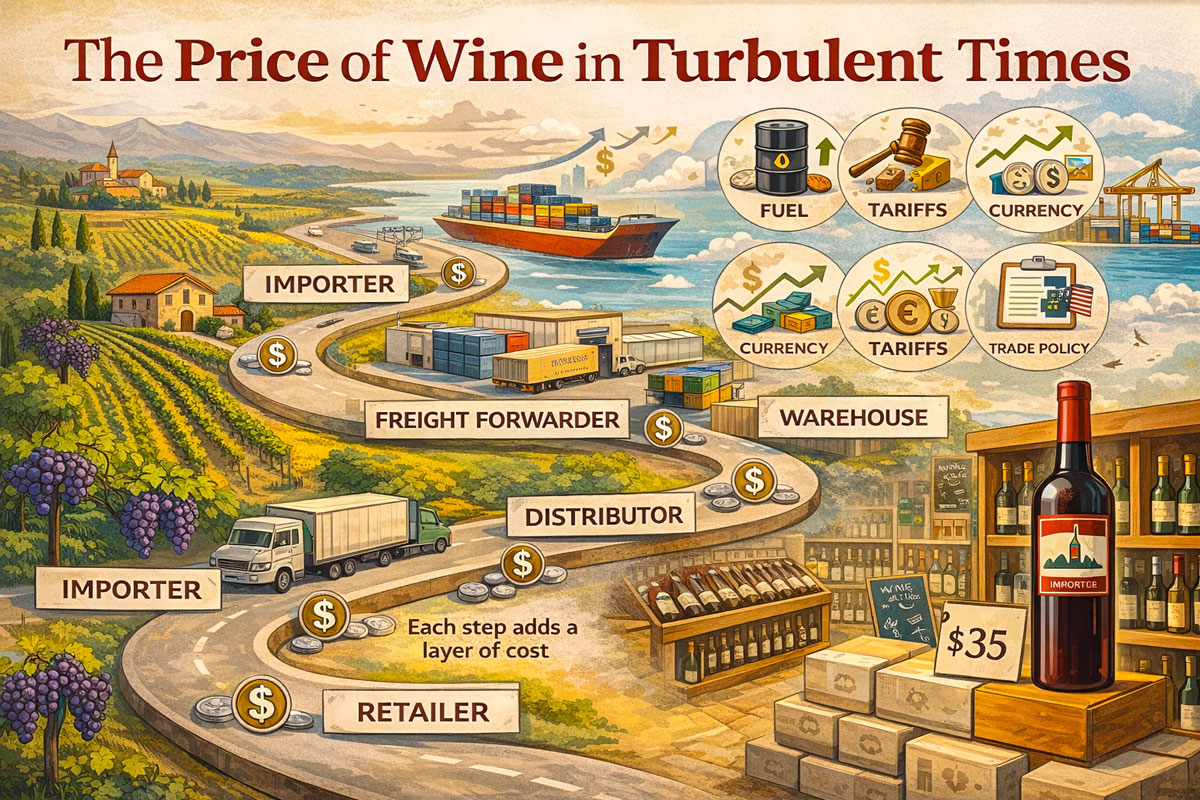
When you examine the traditional path a wine takes from vineyard to glass, you’ll find the moment it leaves the vigneron's cellar, the clock starts ticking, and the nickels start stacking. It starts with the freight forwarder, who arranges the physical movement of wine from the vigneron to the port. Here, a customs broker handles the paperwork and import compliance. From there, a national importer takes ownership of the wine and marks it up before passing it along to a statewide distributor, who marks it up yet again. Finally, the wine arrives at a retail shop, which needs to cover its own costs and turn a reasonable profit. By the time that bottle hits the shelf, the original price from the vigneron may have doubled, tripled, or more. In a nutshell, that's just how the traditional American three-tier distribution system works.
The problem is that each of those links in the chain isn't just adding a nickel; they're adding a hefty percentage. These percentages compound. A national importer might mark up 25–35%. A statewide distributor layers on another 30–40%. The retailer adds their margin on top of that. At every step, the math works against the vigneron at the beginning of the chain and the wine lover at the end of it.
Now layer on top of that the current global reality. Volatile fuel prices lead to wildly unpredictable shipping costs. The supply chain disruptions we've all unfortunately become familiar with add delays, additional warehousing costs, and logistical headaches.
Currency fluctuations affect the landed cost of European wines before a single markup is applied. And then there are the tariffs. New and proposed tariffs on European imports threaten to add yet another compounding layer to an already stacked cost structure. For a small family vigneron working on thin margins, this isn't abstract trade policy; it's existential stress. And for wine lovers, it translates directly into higher prices on our favorite adult beverage.
It gets especially frustrating for me when you consider the old-school national importer model. The large national importer is usually the most expensive and the least equitable link in the logistics chain. Many small European vignerons are still operating under import contracts negotiated by their parents, or even their grandparents. These agreements lock producers into unfavorable terms with the national importer behemoths, giving the importer significant leverage to beat nickels out of the folks who actually grow the grapes and make the wine. After slapping their nickel on, that importer sells to a statewide distributor, who adds their 30–40% on top. By the time the wine clears those two hurdles alone, the economics have become almost comical, if they weren't so frustrating.
Here's the better model, and it's the real secret to fair wine pricing in Western North Carolina: the independent local or regional importer who is also the distributor. By collapsing two tiers into one, and importing and distributing directly, this model eliminates a full layer of cost. We're talking about a meaningful reduction, something in the range of a third of the cost that the traditional three-tier import-and-distribute structure would otherwise bake in. It's as close to direct-to-consumer pricing as the American regulatory system realistically allows. And it's built on relationships — with producers, with retailers, with the people who actually drink the wine.
That's the foundation of how we source wine here at the AWM, and it works in two ways. First, we work directly with importer friends and partners we know and trust, to source our own selections using a model as close to direct import as possible. That relationship allows us to pass real, tangible savings on to AWM customers rather than passing on the inflated costs from intermediaries in other parts of the country. Second, we work with wines sourced by local and regional importers who are also distributors. That's the critical detail: they import, and they distribute. One entity, one margin, two jobs done. It cuts out an entire tier and brings the price of wine meaningfully closer to what it should be.
Both of those approaches are rooted in the same intention. On the other side of the Atlantic, it's about supporting the small local and regional vignerons who make honest wine and deserve to be paid fairly for it. On this side, it's about supporting the local and regional businesses that have built their livelihoods around connecting our community to those producers. It's a supply chain built on equity and mutual respect rather than contractual obligation with strangers. In these turbulent times, those relationships are the gold standard.
That brings me to something I want to make sure our locals and regional regulars know about: the AWM Local Pricing Program. As Asheville has grown into one of the most visited small cities in the South, our shop sees a lot of traffic from visitors here for weekend visits. That's wonderful, and we welcome everyone. But over the years, it became important to me to find a way to do something meaningful for the people who actually live here, or who visit regularly enough to feel like they do. The Monday newsletter was the beginning of that. Local pricing was the next step. And now, I’ve designed a simple web app you can use to find your Local Price while you shop.
Here's how it works. On wines I source directly, or wines that come through our local and regional importer partners, you'll notice a handwritten number on the shelf tag. Those wines are enrolled in the local pricing program. Scan the QR code to pull up the AWM web app, enter that number, and your local price appears on the screen.
No download is required, and nothing is installed on your phone. It runs directly from the AWM website; it's a quick and simple way to see your local price. Remember, too, that locals and email subscribers get the price on bottle one. Not bottle six. Bottle one.
Next time you're in, we're happy to walk you through it.