
Along with selling wine, the most satisfying part of my job is helping people learn about wine. I’ve noticed over the years that most folks aren’t confused about wine because they “can’t taste.” They can taste just fine. They feel lost or confused because tasting notes often sound like a secret language, and nobody has given them the codebook.
This series is about the language of wine. Not the flowery, purple prose pontificated by the wine press. And definitely not the intimidating language of your uncle, the know-it-all somm. I’m talking about a practical way to describe what’s happening in your glass so you can buy with confidence and talk about wine like a pro.
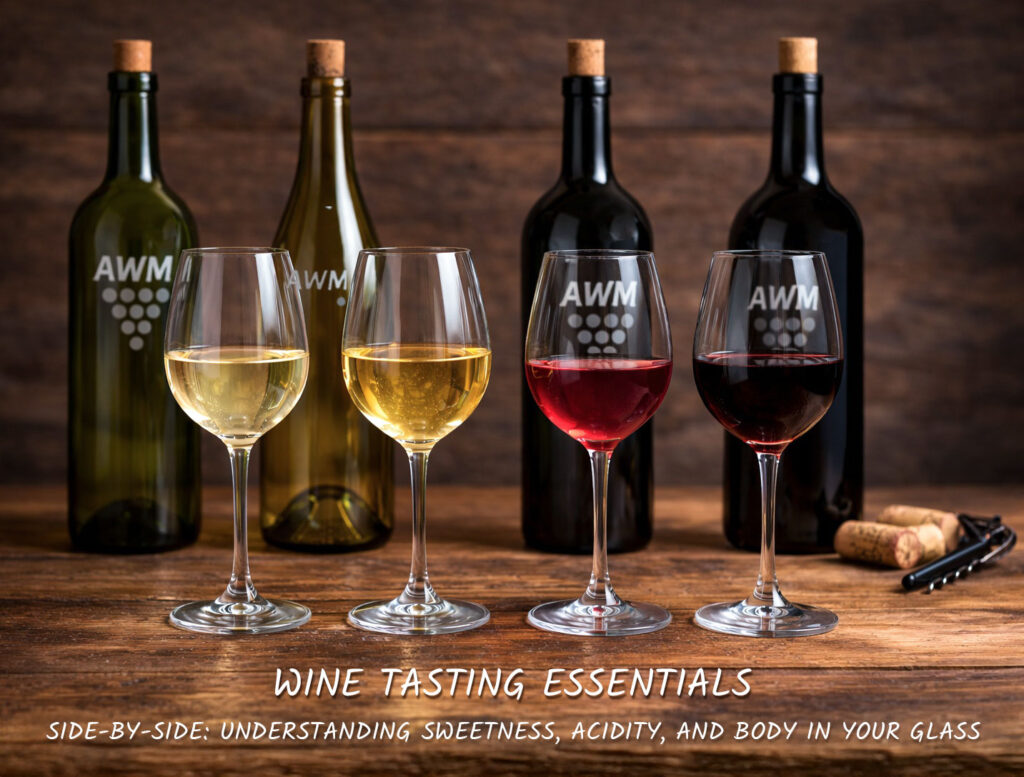
In Part 1,we’ll focus on three basics that everyone knows and can feel: sweetness, acidity, and body. We’ll take a look at two small lineups, two whites and two reds, to show how wines of the same color can behave completely differently, even when they’re all dry and not relying on oak. When you taste and compare these side-by-side, and pay attention to your cheeks, tongue, and gums, you’ll walk away with a simple framework you can use the next time you’re standing in front of a shelf wondering what to bring home.
Tasting notes don’t have to be poetry. When distilled down to the basics, they’re just a shared language for three things you can actually feel in your mouth: sweetness, acidity, and body. Once you can name those three, everything else gets easier, and from there you can add more complex descriptors. This way, you stop guessing, and suddenly, it seems like you can genuinely verbalize what is in your glass.
Let’s start with sweetness. This is the one that seems to baffle folks the most. Sweetness is sugar. “Fruity” or fruit sweetness is not sugar. Think of it like the difference between biting into a ripe peach and sipping peach soda; one tastes fruit sweet, the other is sugary sweet. A dry wine can offer hints of peaches, oranges, strawberries, or cherry candy while still having basically no residual sugar. At the shop, we often describe these dry wines as having “nice sweetness of fruit.”
Acidity is easiest to feel once you know what to look for. It’s the wine world’s version of squeezing a lemon; the mouth-watering snap that shows up under your tongue and along the sides of your cheeks. To teach your palate that sensation, you want a high-toned, lighter-bodied white. This is where Sauvignon Blanc, Jacquère, and Muscadet shine. They’re not “better” than other whites. They’re clear examples of what acidity feels like when it’s turned up a notch or two in your glass.
White Wines
Here’s a fun way to do a white side-by-side comparison at home. Pour two glasses. Make one a “zippy” pick: Sauvignon Blanc, Jacquère, or Muscadet. Make the other a “rounder” pick: unoaked Chardonnay or a Southern Rhône white blend. When your ready to taste, ignore the fancy terms and just check sweetness: after you swallow, does the wine finish clean and dry, or is there a gentle echo of fruit sweetness on your tongue—not sugary sweetness, just fruit sweetness?
Now sip the zippy wine. Does your mouth water right away, and do you feel a little pucker in your cheeks? Now put that next to a rounder white that’s still dry, but with lower acidity and more body. Unoaked Chardonnay is perfect for this. So are many Southern Rhône white blends built from grapes like Viognier, Roussanne, Clairette, and Grenache Blanc. These wines tend to feel broader and warmer on the palate, with less zip up front. Remember, we haven’t even gotten to flavors yet. You’re just noticing what happens to the shape of the wine in your mouth.
Next, the wine’s body. Body is weight, not intensity. The classic example from just about every wine book on the planet is skim milk versus whole milk. Both can be cold and refreshing; however, one has more weight and texture. Sauvignon Blanc, Jacquère, and Muscadet are in the skim camp. Unoaked Chardonnay (except for Chablis, which sits in the middle) and Southern Rhône white blends usually reside in the whole-milk camp.
Red Wines
Red wine works the same way as white wine. You can still check sweetness, acidity, and body, even though the flavors are darker and the texture can be a bit more complicated. Start with sweetness: dry red table wines can smell like ripe fruit, which can trick your brain into expecting sugar. After you swallow, ask the same question you asked with whites. Does it finish clean and dry, or do you get a little echo of fruit that reads as “sweet” even though it isn’t?
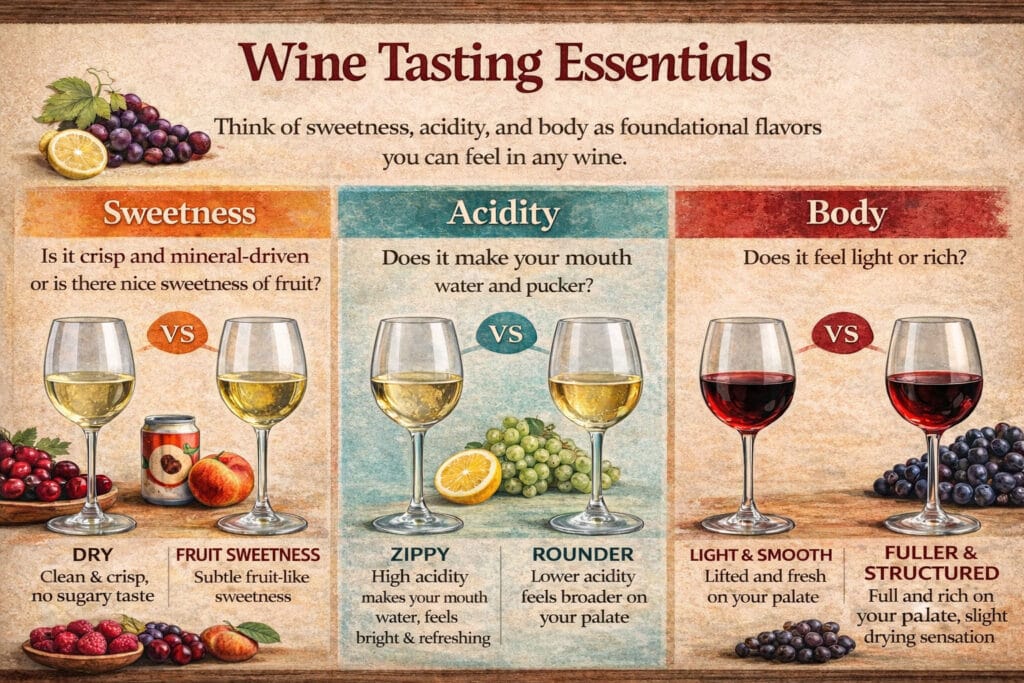
With reds, acidity rarely feels like the white wine lemon-squeeze comparison; however, it still shows up as lift and mouthwatering energy. Pinot Noir and Gamay are great examples, as they tend to have enough acidity to keep them lively and usually feel light to medium-bodied on the palate. Pinot Noir generally offers a smoother, more streamlined texture, while Gamay can feel especially bright and lively, particularly from cooler or limestone-influenced terroir. Don’t chase tasting-note vocabulary yet. Just notice how fresh the wine feels and how fast it moves across your palate.
When assessing body in reds, tannin joins the conversation. Body is still all about weight, not just intensity. Reds can range from almost weightless to broad and lush. Compare Pinot Noir or Gamay to something with more body, like Spanish Garnacha, Southern Rhône blends, or, for even more structure, a Bordeaux blend. Garnacha often shows how body can increase without adding much tannin. Bordeaux blends and Southern Rhône red blends (Grenache, Syrah, Mourvèdre) take you further into structure, adding more concentration and more tannin. It’s one of the best ways to understand tannin in practice: it’s that black‑tea dryness that settles into your gums and cheeks, leaving a faint chalky sensation after you swallow. If you listen to wine buyers talk about a wine with intense tannins, you may hear a phrase something like: “it put sweaters on my teeth.”
Try the same two-glass method we used for the white wines. Pour one lighter red (Pinot Noir or Gamay) and one fuller or more structured red (Garnacha, Bordeaux, or Southern Rhône). First, do the sweetness check: clean and dry, or fruit-echo that feels sweet but isn’t sugary sweet? Then look for acidity: does the wine make your mouth water and feel energetic, or does it feel softer and warmer? Finally, judge body and grip: does it feel light and lifted, or heavier and more coating, with a drying pull on your gums? If you can answer those three questions, you’ve built a solid foundation for a red-wine tasting note.
If you’d like to try this at home, or maybe turn it into a fun adventure with friends, come by the shop and grab a “Tasting Notes Starter Pack.” One zippy white, one rich, full-bodied white, one light red, one richly structured red. We’ll help you pick out the perfect bottles for the comparison. It’s the quickest way to train your palate with a real taste comparison instead of decoding the abstract descriptions we all read in the wine press.
If you’d prefer a more guided approach, stop in anytime this week, and we’ll run you through the exercise, free of charge, of course. When you stop in, just say you’d like to do the comparison tasting for Part 1 Wine Tasting Essentials.
Pro Tip: I’m always in on Saturday from 10am until around 4pm, so if you’d like a more in-depth experience, stop in this Saturday!