In the last two weeks, we’ve had a detailed look at terroir: the combined influence of soil, climate, slope, and human stewardship on wine. To wrap up the series, this week, we’ll move from concept to the glass, with Burgundy providing perfect proof of terroir in action.
Read Part One here...
Read Part Two here...
Parts One and Two answered the question, "What is terroir?" Burgundy answers the most important one: "Does it really matter?" The answer, in Burgundy, is emphatically and unmistakably, yes. There’s no other wine region on the planet where the effects of place are more clearly visible, more obsessively studied, or more dramatically talked about and tasted than here. Burgundy isn’t a region built around blending; it’s a region built around specific grapes in specific places. For me, it’s the world's greatest example of terroir.
At first glance, Burgundy shouldn't be this complicated. The region's most famous red wines are made almost entirely from a single grape: Pinot Noir. Its most famous whites are made almost entirely from one other grape: Chardonnay. You might expect that simplicity to produce a model of consistency. Instead, Burgundy delivers endless variation with just these two grapes. Move just a few miles up or down the Côte d'Or, and Pinot Noir changes shape. It becomes darker or lighter, firmer or silkier, more floral or more savory. The grape remains the same. It’s the place that changes
Burgundy as a Terroir Laboratory
You may have heard Burgundy described as a patchwork of vineyards. That description is pretty much spot on. The region is divided into villages, and those villages are subdivided into named vineyard sites called climats — specific parcels that have been identified over centuries as having unique growing conditions and distinct personalities that convey the place to what’s in your glass. The basic idea is that a parcel of land can be remarkably different from its neighbor, even when it's separated only by a stone wall or a dirt path. Burgundy took that premise to the next level and built an entire classification system around it.
This nearly manic obsession with place works like a charm in Burgundy, mainly because the region’s two main grapes themselves are virtually transparent, allowing the place to speak through the grape. Pinot Noir is famously sensitive to place. It doesn't muscle over nuance the way more assertive varietals sometimes can. Chardonnay is an equally expressive varietal, capable of showing remarkable differences in texture, acidity, and minerality depending on where it’s planted. Burgundy, in other words, gives terroir the perfect medium through which to speak.
Gevrey-Chambertin
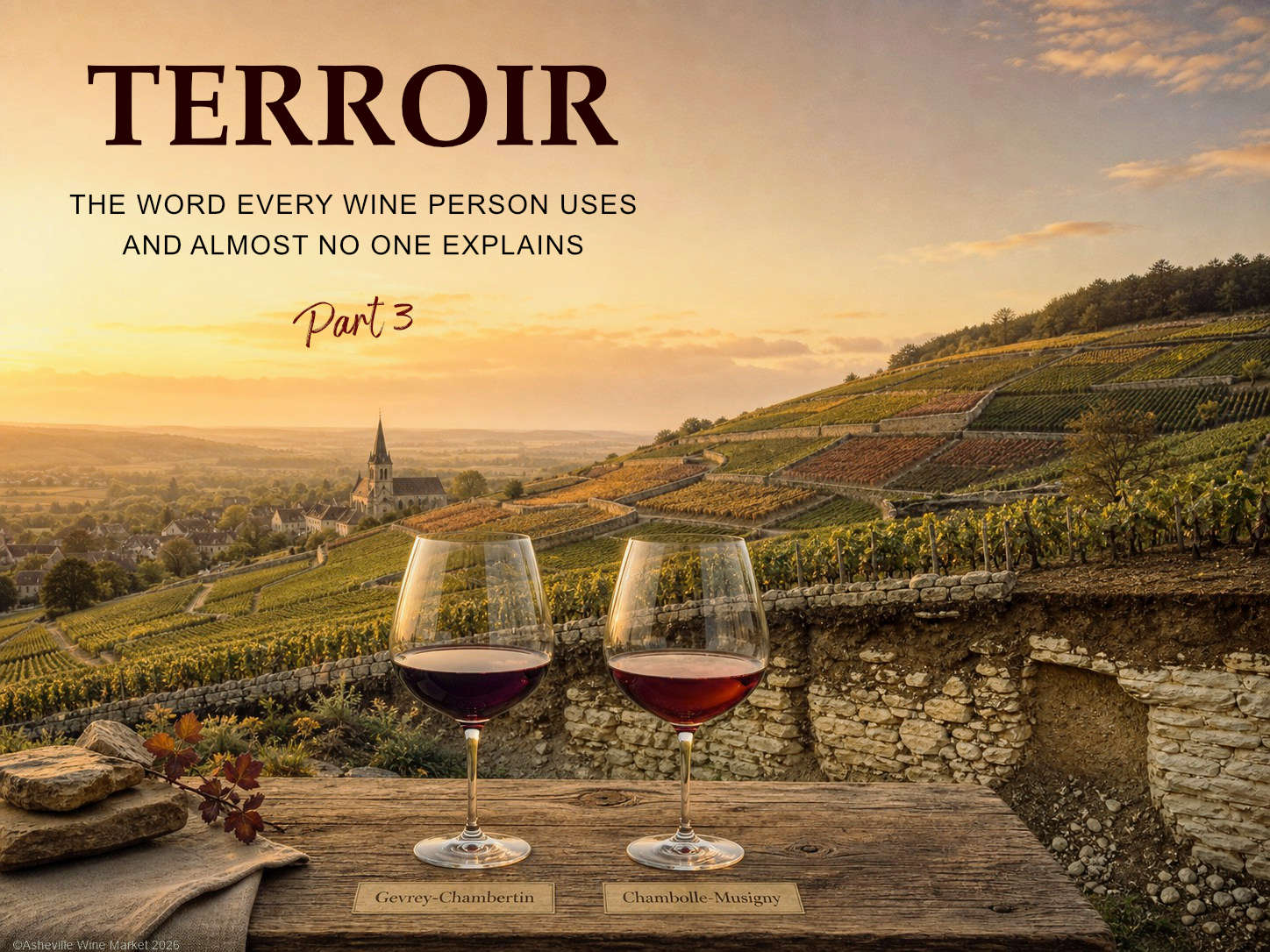
To understand how terroir works in practice, it helps to compare two neighboring villages in the Côte de Nuits, Burgundy's most celebrated red-wine mecca. The first is Gevrey-Chambertin, and merely mentioning this name will make all true Burgundy aficionados weak in the knees. Gevrey sits in the northern part of the Côte de Nuits, and its vineyards are rooted in a mix of limestone, marl, and clay-rich components. Soils here retain moisture better than thinner, rockier sites farther south, and they help produce wines with more concentration and structure.
Wine writers often describe Gevrey-Chambertin with words like powerful, brooding, and masculine because, in the context of Pinot Noir, it carries dark fruit nuances of black cherry, plum, and blackberry. Tannins are a bit firmer than other Burgundies, along with a savory, earthy backbone that can feel almost gamey or meaty as the wine ages. These are wines that reward patience, and collectors love them for precisely that reason.
The reasons for all of this are far from a mystery and have been well documented over the centuries. Gevrey's slope positions, soil composition, and mesoclimate create conditions that consistently push Pinot Noir here toward density of fruit and firm structure.
Chambolle-Musigny
Travel just a few miles south to Chambolle-Musigny, and the transformation is remarkable. It’s still Pinot Noir, and the winemaking tradition and climate are broadly similar, yet the wines seem to come from a different universe altogether. Chambolle-Musigny's soils are generally thinner, stonier, and richer in active limestone, with less clay than Gevrey. They drain more quickly, forcing vines to work harder, yielding wines of greater finesse and aromatic lift.
If Gevrey-Chambertin is about structure and depth, Chambolle-Musigny is about grace. These wines are often described as silky, ethereal, and perfumed. Instead of black fruit and savory earth, you may find red cherry, raspberry, rose petal, violet, and spice. The tannins tend to be finer and a little more relaxed. The texture can seem almost weightless, and yet the best examples are far from fragile; they’re precise, haunting, and deeply persistent.
This is terroir speaking loud and clear. The thin limestone-driven soils and subtle differences in exposure and drainage change the way Pinot Noir ripens and translates to the glass.
Take the same grape, from the same region, sourced only a few miles apart, vinified and aged in a similar fashion, and in Burgundy, the difference can be seismic.
Exploring Terroir On Your Own
Here’s the main take-away and the central lesson of terroir: wine is capable of transmitting place with extraordinary sensitivity. Once you know that, a wine label starts to read differently. The village name, the vineyard name, the slope, the stones, and even the cool morning air and the drainage after a storm all matter.
You can take it a step or two further; Burgundy is only the beginning. Terroir explains why a Chardonnay from Chablis is tense, citrusy, and chalky while a Sonoma Coast Chardonnay is broad and ripe. It explains why a Cabernet from Napa Valley tastes different from one grown in Walla Walla, and why a red from Portugal's schist-lined Douro Valley feels so different from a granite-influenced wine from Vinho Verde.
The best way to understand terroir isn’t to memorize definitions, it’s by tasting comparisons. Try two wines made from the same grape but grown in different places. Pinot Noir is a great starting point; however, Chardonnay works beautifully too: Chablis next to California Chardonnay is practically a masterclass in climate and soil.
Pour both wines side by side and taste them first, without food. Which one feels lighter? Which one has more acidity? Which one smells more floral, more earthy, more ripe, more restrained? Pay attention not just to fruit flavor but to texture, energy, and shape. Noticing these differences is the beginning of tasting terroir.
So yes, folks in the wine trade say terroir a lot, and I’m quite often guilty myself; however, stripped of any sales-speak or purple prose, it refers to something real, concrete, and deeply worth understanding. Terroir is why wine can tell you where it came from in a way that few other adult beverages can. It’s why wines from one village taste bold and dark, while in the next village just down the road, the wines are lifted and floral. It is why place matters, and why for me, wine is one of the most intellectually stimulating and rewarding beverages to pour in your glass.
